
Let’s be real—AI isn’t just for tech giants with massive budgets anymore. It’s here, it’s accessible, and it’s a powerful tool that small businesses can use right now. Think of it less like a sci-fi robot and more like the most efficient employee you’ve ever hired, one who loves handling the tedious stuff so you can get back to building your business.
AI Is No Longer a “Someday” Thing for Small Businesses
Artificial intelligence is fundamentally reshaping what it means to run a small business. It’s the ultimate equalizer, giving entrepreneurs and lean teams the ability to automate routine tasks, uncover powerful insights from their data, and provide the kind of customer service that used to require a whole department. This shift lets you compete head-on with much larger companies, punching far above your weight.
The days when you needed a data scientist on staff to make sense of your business are over. Today’s AI tools are practical, affordable, and built for people who aren’t tech experts. They’re designed to solve the exact problems you face every single day.
From Novelty to Necessity
The speed at which small businesses are adopting AI tells you everything you need to know. Just back in 2023, you’d find only about 20% of small businesses experimenting with AI, treating it more like a curious new toy.
Jump ahead to late 2025, and that picture has completely changed. A recent survey shows an incredible 92% of small business owners now use AI in their daily operations. This isn’t just about jumping on a bandwagon; it’s a strategic move to stay competitive and drive growth. Businesses that get on board are saving a ton of time and money, which they can pour right back into new ideas, better customer relationships, and growing the company.
“AI is about giving you back your most valuable asset: time. By automating the repetitive, you unlock the creative and strategic parts of your brain that truly drive the business forward.”
Tapping Into Real Opportunities, Right Now
The best part is that you don’t have to wait years to see a return. The benefits of AI are immediate and real. From marketing your products to managing your inventory, there are quick wins that can start making a difference from the moment you implement them. It’s all about working smarter, not just harder.
Here are a few ways AI can start helping your business immediately:
- Marketing and Sales: AI can dig through your customer data to pinpoint new sales opportunities, help you write engaging social media content, and fine-tune your website to attract more visitors. This is where topics like AI Search Engine Optimization become incredibly valuable.
- Customer Service: Imagine offering your customers instant, 24/7 support. AI-powered chatbots can handle common questions on the spot, freeing up your team to solve the more complex, human-centric problems.
- Operational Efficiency: Let AI take over the drudgery. It can manage appointment scheduling, track inventory levels, and even handle basic bookkeeping, which means fewer manual errors and countless hours saved.
Below is a quick look at how these applications translate into direct, tangible benefits for your business.
Quick Wins with AI in Your Business
This table summarizes some of the most immediate benefits small businesses can gain by adopting simple AI tools, showing the direct impact on key business areas.
| Business Area | AI Application | Expected Outcome |
|---|---|---|
| Marketing | Content generation tools | Faster creation of blog posts, emails, and social media updates |
| Sales | AI-powered CRM | Automatic lead scoring and identification of high-value prospects |
| Customer Service | Chatbots on your website | 24/7 instant answers to common questions, improved customer satisfaction |
| Operations | Automated scheduling software | Reduced time spent on booking appointments and managing calendars |
| Finance | Expense tracking apps | Automated categorization of receipts and simplified bookkeeping |
These are just the starting points. This guide is designed to give you a clear, actionable roadmap for making AI a core part of your success story. Let’s get started.
Putting AI to Work in Your Daily Operations
It’s one thing to talk about the theory of AI, but it’s another thing entirely to see it solve the real, everyday problems you face as a small business owner. The magic of AI for small business isn’t in some far-off, futuristic concept; it’s in practical, on-the-ground applications that save you time, cut costs, and help you build stronger customer relationships.
Think of AI less like a single, all-powerful robot and more like a specialized toolkit. You’ve got specific tools for marketing, others for customer service, and a whole set designed to simplify the complex dance of daily operations. Each one is built to tackle a common pain point, turning tedious manual chores into smooth, automated workflows.
This visual breaks down how AI’s core benefits directly address the biggest hurdles small businesses have to clear every day.
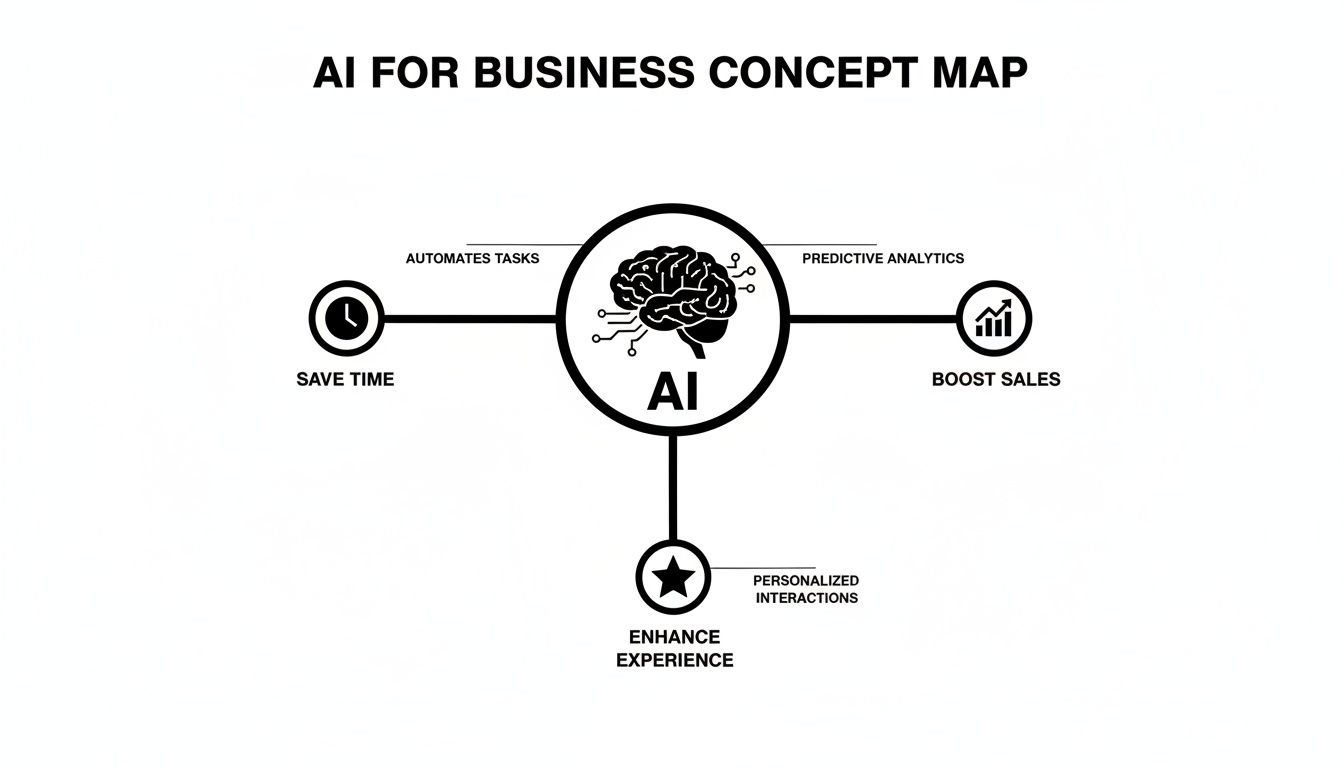
As you can see, the main advantages—saving time, boosting sales, and improving the customer experience—make AI a powerful ally for any business focused on growth and efficiency.
Rethink Your Marketing and Sales
Marketing can often feel like you’re just shouting into the void, hoping someone listens. AI can act as your personal strategist, helping you craft messages that actually connect and making sure they land in front of the right people at the perfect moment. It’s all about working smarter, not just louder.
Take content creation, for example. We all know it can eat up hours of the week. AI writing assistants can brainstorm blog post ideas, whip up first drafts for social media captions, or even help you nail that catchy email subject line. It’s not about replacing your voice; it’s about getting a solid draft on paper in minutes, not hours, so you can spend your time on strategy and adding that human touch.
SEO is another area where AI is a game-changer. These tools can analyze keywords, pinpoint the topics your audience is actively searching for, and even suggest tweaks to your website to help you climb the search rankings. It takes a lot of the guesswork out of getting found online.
AI helps you shift from a “best guess” marketing plan to one built on hard data and predictive insights. It’s like knowing what your customers want before they even have to ask.
Elevate Your Customer Service
For a small business, incredible customer service is your secret weapon. The problem? You can’t be available 24/7. AI offers a realistic way to provide instant support without needing a team working around the clock.
AI-powered chatbots are the perfect example. Add one to your website or Facebook page, and it can instantly answer common questions like, “What are your hours?” or “Do you have this in stock?”. That immediate response keeps customers happy and frees up your team to handle the more complex issues that need a personal touch.
These tools also collect valuable feedback along the way, giving you a clear picture of common pain points so you can improve your products or services. For a real-world look at this, an in-depth article on AI receptionist for small business efficiency shows how these systems can manage appointments and answer calls, acting as a virtual front desk that never takes a day off.
Streamline Your Internal Operations
Behind every great small business is a mountain of admin work. Scheduling, inventory, finances—these tasks are essential, but they can easily swallow your entire day. This is where AI really shines as an operational powerhouse.
Think about these common bottlenecks and how AI offers a fix:
- Inventory Management: AI can look at past sales and predict future demand with surprising accuracy. For a local bakery, that means knowing exactly how many croissants to bake for the Saturday morning rush, cutting down on waste and disappointed customers.
- Appointment Scheduling: Instead of the endless email chains, AI schedulers sync with your calendar and let clients book a time that works for them automatically. This one change can easily give you back hours every single week.
- Financial Admin: Modern accounting software uses AI to categorize expenses for you. Just snap a photo of a receipt, and the system intelligently logs the details. It saves you from mind-numbing data entry and helps avoid costly mistakes.
By handing off these repetitive jobs to smart systems, you free yourself up for the work that actually grows your business: thinking strategically, innovating, and talking to your customers. Adopting AI isn’t about some massive, expensive overhaul. It’s about making small, intelligent changes that pay off big in time and productivity.
Building Your Simple AI Adoption Roadmap

Jumping into AI for small business can feel like trying to drink from a firehose. With a dizzying array of tools and possibilities, the hardest part is often just knowing where to start. The secret? Ditch the idea of a massive, company-wide overhaul and focus on getting small, strategic wins under your belt.
This is where a simple, phased roadmap becomes your best friend. Think of it like building with LEGOs—you start with one small piece, see how it fits, and then gradually add more until you’ve created something impressive. This approach takes the guesswork out of the equation and lets you build your AI capabilities with confidence, one step at a time.
Having a structured plan is vital. While optimism is sky-high, the practical hurdles are very real. Research shows 81% of small businesses believe AI is essential for growth, and 94% of those already using it are seeing positive results. But on the flip side, 45% feel they don’t have the technical know-how, which is exactly why a clear plan is so critical. You can learn more about these small business AI trends and see why a roadmap makes all the difference.
Phase 1: Assess and Identify
Before you get distracted by shiny new tools, the first step is to look inward. Your goal here is simple: find the low-hanging fruit. You’re on the hunt for tasks that are repetitive, rule-based, and eat up way too much of your day.
Grab a notepad or open a spreadsheet and start jotting down all the daily and weekly activities that bog you and your team down. Don’t hold back—write down everything from manually answering the same five customer questions over and over to spending hours formatting a weekly sales report. These are your prime candidates for an AI assist.
Ask yourself these questions to zero in on the best opportunities:
- What tasks are boring but necessary? Think data entry, scheduling appointments, or transcribing meeting notes.
- Where do manual errors pop up most often? AI can bring military-grade precision to things like calculating sales commissions or managing inventory.
- Which activities are keeping you from focusing on growth? If you’re stuck managing your social media calendar by hand, you’re not out building relationships with clients.
Once you have your list, circle the top three to five tasks that cause the most headaches. This shortlist is your starting line for the next phase.
Phase 2: Pilot and Test
Now that you’ve pinpointed a specific problem, it’s time to find a tool to solve it. In this phase, your motto is “start small, test fast.” You aren’t committing to some expensive, long-term solution here. You’re just running a small, low-risk experiment to see if AI can actually move the needle.
Let’s say you identified “answering repetitive customer inquiries” as a major time-suck. Your pilot project could be as simple as testing a free-tier chatbot on your website for two weeks.
Your goal during the pilot phase isn’t perfection; it’s proof of concept. You want to answer one simple question: “Does this tool save us time, money, or hassle?”
To run a successful pilot, just follow these steps:
- Choose a Single Problem: Don’t try to boil the ocean. Stick to just one of the pain points you identified in your assessment.
- Select a Low-Cost Tool: Look for tools with generous free trials or cheap entry-level plans. The idea is to test the waters without a big financial splash.
- Define a Simple Metric: How will you know if it’s working? It could be “hours saved per week,” “number of support tickets resolved automatically,” or “increase in website appointments booked.”
- Evaluate the Results: After the test period, look at your metric. Did the tool deliver? Was it easy for your team to use?
This pilot gives you real data, not just hype, to decide if the AI solution is worth investing in further.
Phase 3: Scale and Integrate
Once a pilot project proves its worth, you’re ready for the fun part: scaling up. This final phase is all about thoughtfully expanding the use of a successful AI tool and weaving it into the fabric of your daily workflow.
Scaling doesn’t mean forcing everyone to use the new tool overnight. It’s a more gradual process of integration and training. For example, if your chatbot pilot was a hit, scaling might mean adding it to more pages on your site, connecting it to your CRM, and training your whole customer service team on how to use it effectively.
As you scale, you start to create a powerful AI ecosystem where different tools talk to each other, creating a flywheel of efficiency. Your AI scheduler feeds data into your AI-powered CRM, which then helps inform your AI marketing campaigns. This interconnected approach is how you truly transform your operations and build a smarter business from the ground up.
Top AI Tools to Supercharge Your Business
Alright, you have a roadmap, now let’s get you the right tools for the journey. The world of AI for small business can feel like a crowded, noisy marketplace, but you don’t need a hundred different apps to see a real difference.
The secret is starting small with a handful of user-friendly tools that solve your biggest daily headaches. We’ve handpicked some of the best options out there for entrepreneurs who need results without the steep learning curve or hefty price tag.
Tools For Content Creation And Marketing
Content is the lifeblood of your marketing, but creating it consistently can feel like a full-time job. AI content tools can become your creative co-pilot, helping you brainstorm ideas, write copy, and design visuals in a fraction of the time. This frees you up to focus on the bigger picture—your strategy and your customers.
- ChatGPT: If you haven’t used it yet, this is the place to start. Think of it as an incredibly versatile assistant. It can write a first draft of a blog post, spitball email subject lines, summarize a dense article, or even help you script a social media video. Its simple, conversational style makes it unbelievably easy to use.
- Canva Magic Studio: Canva is already a go-to for many small businesses, but its AI features are a game-changer for visuals. You can generate completely new images from a text description, automatically design a slide deck, or use its “Magic Write” feature to whip up social media captions without ever leaving your design.
- Grammarly: This is so much more than a spell-checker. Grammarly’s AI helps you nail the right tone, write with clarity, and get your point across effectively. It ensures every email, report, and social media update is polished and professional, which is crucial for protecting your brand’s image.
To get the most out of these tools, it helps to have a solid plan. Our guide on effective social media marketing strategies will give you the framework you need to put your new AI-powered content to work.
Tools For Customer Support And Engagement
For small businesses, amazing customer service is how you win. AI can help you deliver instant, 24/7 support without having to hire a round-the-clock team, making sure your customers feel heard and taken care of anytime they reach out.
- Tidio: This platform neatly bundles live chat, chatbots, and email marketing into one dashboard. You can launch an AI chatbot in minutes to answer common questions, qualify new leads, and pass the trickier issues to a real person. It’s a fantastic way to slash your response times.
- Zendesk AI: If your support needs are growing, Zendesk uses AI to help you manage the volume. It can automatically sort support tickets, suggest ready-made answers to your agents, and build out a smart help center for customers. The result? Your team solves problems faster and more consistently.
The point of AI in customer service isn’t to get rid of the human touch. It’s about letting the bots handle the repetitive stuff so your team can focus on the conversations that really count.
Tools For Productivity And Operations
Often, the most impactful AI tools are the ones that work behind the scenes, automating the tedious administrative tasks that eat up your day.
- Calendly: Say goodbye to the endless email chains trying to book a meeting. This AI-powered scheduler lets you set your availability and share a link. Clients or partners can then pick a time that works for them, and it all syncs to your calendar automatically, complete with reminders.
- Notion AI: Built right into the popular Notion workspace, this AI can instantly summarize your meeting notes, pull out action items, or turn a messy brainstorm into a structured table. It’s perfect for organizing your thoughts and turning ideas into plans.
- QuickBooks Online: Modern accounting software has some clever AI built-in. It learns your spending patterns to automatically categorize expenses, flags potential errors or duplicate charges, and generally makes bookkeeping far less painful. It saves hours of manual work.
Comparing AI Tools For Key Business Tasks
To make it even easier, here’s a quick-glance table comparing some of the most popular, budget-friendly tools perfect for getting started.
| Tool Name | Primary Function | Best For | Starting Price |
|---|---|---|---|
| ChatGPT | Content & Idea Generation | Writing blog drafts, social media copy, emails, and brainstorming. | Free |
| Canva Magic Studio | Visual Design & Copywriting | Creating social graphics, presentations, and marketing materials. | Free (Pro plan recommended) |
| Tidio | Customer Support | Small businesses wanting an all-in-one live chat and chatbot tool. | Free |
| Calendly | Scheduling & Admin | Service-based businesses that book many appointments. | Free |
| Notion AI | Productivity & Notes | Organizing projects, summarizing meetings, and planning content. | Add-on to Notion plans |
This isn’t about adopting every tool at once. Just pick one that solves your biggest headache right now. Master it, see the results, and then build from there.
Measuring Your AI Return on Investment
Bringing any new tool into your business is an investment, not just an expense. When it comes to AI for small business, you have to know that it’s actually pulling its weight. The good news? You don’t need a Wall Street-level financial model to figure it out. Gauging your return on investment (ROI) is really about seeing tangible, real-world improvements in your day-to-day work.
Let’s put it in simple terms. Say you sign up for an AI scheduling assistant for $20 a month. If that tool saves you just two hours of back-and-forth emailing to book meetings, you’re already winning. Your time is your most valuable asset, and AI is one of the best ways to get more of it back.
Identifying Key Performance Indicators
Before you can measure success, you have to decide what success actually looks like for you. The right metrics will always depend on the specific problem you’re using AI to solve. The key is not to get bogged down in a spreadsheet full of numbers. Instead, pick a few key performance indicators (KPIs) that are directly connected to your goals.
Your KPIs should be simple, trackable, and directly related to the AI tool you’ve adopted.
- Time Savings: This is often the most immediate and satisfying return. Start tracking the hours you or your team get back from tasks now automated by AI—things like drafting social media posts, organizing your calendar, or answering routine customer questions.
- Cost Reduction: This is about hard dollars saved. Has an AI chatbot meant you don’t need to pay for after-hours support staff? Did an AI-powered inventory tool help you reduce spoilage and waste?
- Lead Generation and Sales: If you’re using AI in your marketing, keep a close eye on the numbers. Look for a noticeable bump in website leads, higher email open rates, or a direct increase in sales from your AI-assisted campaigns.
- Customer Satisfaction (CSAT): AI can supercharge your response times. Monitor your customer satisfaction scores, Net Promoter Score (NPS), or just your online reviews to see if that 24/7 availability is making your customers happier.
Understanding AI Pricing Models
Getting a handle on software costs is obviously a huge piece of the puzzle. Most AI tools built for small businesses run on a subscription model, which is great because it avoids a massive upfront cost. But you have to read the fine print to avoid any nasty surprises down the road.
It’s easy to just focus on the monthly sticker price, but that’s a rookie mistake. A smart AI investment means thinking about the total cost, which includes the time it takes for you and your team to get it set up and learn how to use it properly.
Keep an eye out for these common pricing setups:
- Tiered Subscriptions: This is the most popular model. You pay a set monthly or annual fee for a package of features and certain usage limits, like a specific number of users or chatbot conversations per month.
- Pay-As-You-Go: With this model, you’re billed only for what you actually use. It can be fantastic for tools you only need occasionally, but be careful—costs can climb quickly if your usage suddenly spikes.
- Freemium Models: These plans offer a basic version of the tool for free, giving you the option to upgrade for premium features. This is the perfect low-risk way to test-drive a tool and see if it’s a good fit before you pull out your credit card.
When you’re comparing options, always check for hidden fees like setup charges or penalties for going over your usage limits. Your goal is to find a plan that provides a ton of value far beyond what you’re paying each month. By tracking the right metrics, like those detailed in these important Instagram stats for businesses, you’ll have a crystal-clear picture of how a small investment in AI can fuel real, measurable growth.
Navigating Common Pitfalls and Ethical Use
Jumping into AI is exciting, but it’s not a magic wand. If you dive in headfirst without thinking through the potential problems, you can end up with costly mistakes that damage customer trust and make your brand feel fake. The real win comes from striking the right balance between smart automation and essential human oversight.
One of the biggest traps is leaning too heavily on the tech. Sure, you could let an AI writer crank out all your blog posts or have a chatbot field every single customer question. But do that, and you risk sounding generic and cold, losing the very personality that makes your business yours.
Then there’s the critical issue of data privacy. The moment you start feeding customer information into an AI tool, you’re responsible for keeping that data safe. If you want to get a better handle on protecting your company’s digital footprint, our in-depth guide on VPNs and online security is a great place to start.
Balancing Automation and Authenticity
The sweet spot is creating a system where AI assists, it doesn’t take over completely. This “human-in-the-loop” approach is your key to maintaining quality control and your brand’s unique voice. Let the AI generate a first draft, but have a real person refine it. Let a chatbot handle the simple stuff, but make sure it can seamlessly pass a frustrated customer to a human agent.
Being upfront with your customers is just as important. Don’t hide the fact that you’re using AI. A simple note on your chatbot or in your privacy policy goes a long way in building trust.
Think of AI as an incredibly smart intern. It can do the heavy lifting, research, and initial drafting, but you, the expert, must provide the final review, strategic direction, and authentic voice.
Ethical AI in Practice
Using AI the right way means being mindful of the new challenges it creates. While 58% of small business owners are now using generative AI, a nearly equal 59% are worried about messy compliance rules. This stat really drives home why a careful, thoughtful approach is so important, as you can discover more about these small business technology trends in recent industry reports.
Here are a few simple rules to live by:
- Always Review AI Output: Never just copy and paste. Read everything over for accuracy, tone, and to make sure it actually sounds like you.
- Protect Customer Data: Stick with well-known AI tools that have clear, understandable privacy policies.
- Be Transparent: Always let people know when they’re talking to a bot, not a person.
Answering Your Top AI Questions
It’s smart to have questions as you think about bringing AI into your business. Most entrepreneurs we talk to have the same handful of concerns pop up again and again. Let’s tackle them head-on so you can move forward with confidence.
How Much Should I Budget for AI Tools?
This is always the first question, and the answer surprises a lot of people: you can start for free. Seriously. Many of the most useful AI tools out there, from content assistants to meeting schedulers, have incredibly generous free versions. These are perfect for dipping your toes in the water and running a few small tests to see if a tool actually works for you before spending a dime.
When you’re ready to get more serious, you’ll find that most subscriptions for small business tools are pretty reasonable, typically falling in the $10 to $50 per month range. The trick is to start small. Pinpoint one specific problem, find a low-cost tool that solves it, and make sure the value you get—whether in time saved or new revenue—easily covers that small monthly fee.
Do I Need to Be a Tech Whiz to Use AI?
Not at all. The entire point of this new wave of AI for small business is that it’s built for everyone else—the marketers, the shop owners, the consultants. If you can write an email or post on Instagram, you already have all the technical skills you need.
These tools are designed with simple, clean interfaces. You don’t need to understand coding or complex algorithms. You just need a clear idea of what you want to get done, and the software will walk you through it.
The best modern AI tools aren’t built for data scientists; they’re built for business owners. The focus is on simplicity and immediate results, not technical jargon.
Is AI Going to Replace My Team?
It’s much more useful to think of AI as a super-powered assistant rather than a replacement for a person. AI is fantastic at the tedious, repetitive tasks that drain your team’s energy—things like writing first drafts of social media posts, handling common customer questions, or sorting through data.
This doesn’t make your people obsolete; it makes them more powerful. By handing off the grunt work to AI, your team is freed up to focus on the things that actually require a human touch: building strong customer relationships, thinking strategically, and coming up with creative solutions. AI helps your current team do more of what they do best.
How Do I Know My Business Data Is Safe?
That’s a critical question, and you’re right to ask it. The best way to protect your information is to stick with reputable, well-known AI providers that are transparent about their privacy policies. Before you sign up for anything, take five minutes to read how they handle and store your data.
As a rule of thumb, avoid uploading highly sensitive customer information (like personal or financial details) into any new or unvetted platform. If you stick with the major players who have a long history of taking security seriously, you can use these powerful tools safely.
At Swype Inc., we’re focused on giving entrepreneurs the practical knowledge they need to get ahead. For more tips on technology and digital marketing, check out our blog. You can learn more about what we do on our website.

